
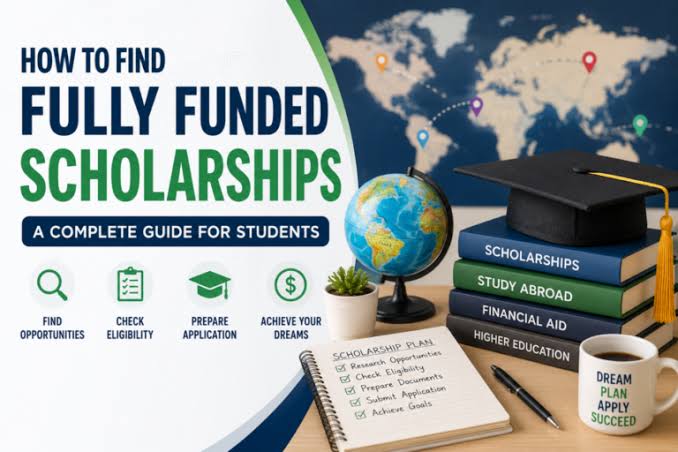

For many students, pursuing higher education abroad is a dream that comes with significant financial challenges. Tuition fees, accommodation, travel expenses, living costs and other academic requirements can make studying at an international university seem financially impossible. However, scholarships provide an opportunity for talented and ambitious students to access quality education without having to shoulder the entire financial burden.
Every year, governments, universities, international organisations, foundations and private institutions offer thousands of scholarships to students from different parts of the world. Some cover tuition fees only, while others provide comprehensive funding that includes accommodation, monthly stipends, travel expenses, health insurance and other study-related costs.
With most scholarship applications now accessible online, students can search for opportunities and submit applications from virtually anywhere in the world. However, finding a scholarship is only the first step. Understanding its requirements, preparing the necessary documents and presenting a convincing application are what can make the difference between being selected and receiving a rejection.
Whether you are a recent university graduate, a working professional or someone looking to pursue postgraduate studies abroad, this guide explains how to identify suitable scholarships, prepare competitive applications and improve your chances of securing funding.
1. Start Your Scholarship Search Early
One of the biggest mistakes scholarship applicants make is waiting until the last minute to start looking for opportunities.
Most international scholarships have application periods that open several months before the intended academic year. Some require applicants to secure university admission before applying, while others have separate selection and interview stages.
Starting early gives you enough time to understand the requirements, prepare your documents, contact referees and research the universities offering your preferred programmes.
Before beginning your search, establish what you want to study and where you would like to study. Consider your academic background, career interests, preferred countries and the level of education you intend to pursue.
For example, if you have completed a bachelor’s degree in accounting and would like to pursue a master’s degree in economics, finance or public policy, your search should focus on scholarships and universities offering programmes related to those fields.
Having a clear academic direction makes it easier to identify opportunities that match your qualifications.
2. Use Reliable Websites to Find Scholarship Opportunities
The internet provides access to numerous scholarship opportunities, but not every website advertising scholarships is reliable.
Some websites publish outdated opportunities, while others circulate misleading information or fraudulent scholarship advertisements. To avoid wasting time, prioritise official scholarship portals, university websites and recognised international organisations.
Some of the most popular scholarship providers and platforms include:
- Chevening Scholarships: A UK government-funded programme supporting emerging leaders pursuing one-year master’s degrees in the United Kingdom.
- Commonwealth Scholarships: UK-funded scholarships supporting students from eligible Commonwealth countries, particularly those whose studies can contribute to development.
- Erasmus Mundus Joint Master’s Scholarships: European Union-supported opportunities allowing international students to pursue joint master’s programmes offered by universities in different countries.
- DAAD Scholarships: Funding opportunities for international students pursuing higher education in Germany.
- Fulbright Foreign Student Program: A US government-sponsored programme supporting international graduate students and researchers.
- Australia Awards Scholarships: Australian government-funded scholarships supporting students from eligible developing countries.
- University scholarships: Individual universities offer merit-based, need-based and programme-specific scholarships to international students.
You can access these opportunities through their official websites:
| Scholarship provider | Official website |
|---|---|
| Chevening | https://www.chevening.org/ |
| Commonwealth | https://cscuk.fcdo.gov.uk/ |
| Erasmus Mundus | https://erasmus-plus.ec.europa.eu/ |
| DAAD | https://www.daad.de/en/ |
| Fulbright | https://foreign.fulbrightonline.org/ |
| Australia Awards | https://www.dfat.gov.au/people-to-people/australia-awards |
You can also search individual university websites for international student funding, graduate scholarships and postgraduate financial assistance.
A useful practice is to confirm every opportunity on the official website of the organisation providing the funding rather than relying entirely on social media posts or third-party scholarship directories.
3. Understand the Eligibility Requirements Before Applying
Not every scholarship is suitable for every student. Each programme has specific eligibility requirements that applicants must satisfy before they can be considered.
Common requirements include nationality, academic qualifications, professional experience, language proficiency, leadership experience and admission to an approved university or academic programme.
For example, some scholarships are designed specifically for recent graduates, while others target professionals who have several years of work experience.
Understanding these differences is important because applying for a scholarship for which you do not qualify is a waste of time and effort.
Consider some of the major international scholarship programmes and what they generally require.
How to Apply for Fully Funded Scholarships: The Complete Guide (Real Steps, Not Just Tips)
4. Prepare Your Scholarship Application Documents in Advance
Once you have identified scholarships that match your qualifications, the next step is preparing the required documents.
Most international scholarship applications request a combination of academic records, personal information, professional experience and supporting recommendations.
Commonly requested documents include:
Academic transcripts: These provide evidence of your academic performance throughout your university education. Ensure that your transcripts are official, complete and readable.
Degree certificates: These confirm that you have completed the required academic qualification. If you are still studying, some scholarships may accept provisional transcripts or other evidence of your expected graduation.
Curriculum Vitae (CV): Your CV should highlight your education, work experience, internships, leadership responsibilities, volunteering activities, professional training and relevant achievements.
Personal statement or motivation letter: This explains your academic background, reasons for applying, career ambitions and why you are a suitable candidate.
Recommendation letters: These are usually provided by lecturers, employers, supervisors or other individuals who can speak about your abilities and potential.
Passport: Some scholarship providers require a valid passport to confirm your identity and nationality.
English language proficiency results: IELTS, TOEFL or other recognised tests may be required, depending on the scholarship and university. Some institutions offer exemptions where applicants meet specific conditions.
Research proposal: This may be required for research-based postgraduate programmes or doctoral applications.
Not every scholarship requires all these documents. Always follow the official application instructions.
It is advisable to create a dedicated folder on your computer or cloud storage where you can keep digital copies of all your documents. Save them in clearly labelled PDF files and ensure they meet the required file size and format specifications.
5. Write a Convincing Personal Statement
A personal statement is one of the most important components of many scholarship applications.
Your academic transcripts show your grades, but your personal statement gives the selection committee an opportunity to understand your background, motivations, experiences and ambitions.
A strong personal statement should explain:
- Your academic and professional background.
- Why you have chosen the particular course.
- Why you want to study at the selected university.
- How the scholarship will support your ambitions.
- What you intend to achieve after graduation.
- How your education will benefit your community or country.
Avoid writing generic statements that could apply to thousands of applicants.
Instead of saying that you are passionate about leadership, explain an actual experience where you demonstrated leadership. Rather than simply stating that you want to contribute to national development, describe the specific challenge you hope to address and how your proposed studies will equip you to do so.
For example, an economics graduate interested in public policy could explain how postgraduate training would strengthen their ability to analyse economic challenges, contribute to evidence-based policymaking and support inclusive economic growth.
Your personal statement should be authentic, specific and consistent with the rest of your application.
6. Demonstrate Leadership, Work Experience and Community Involvement
Many international scholarships consider more than academic performance.
Some programmes, particularly Chevening, place considerable emphasis on leadership, professional achievements and the ability to influence positive change.
However, leadership does not necessarily mean holding a senior management position or managing a large organisation.
It can involve coordinating a university project, organising a community initiative, leading a student association, mentoring others, volunteering or taking responsibility for solving a problem at work.
Similarly, professional experience does not always have to come from a permanent full-time job. Internships, volunteering and other activities may be relevant depending on the scholarship’s definition of eligible experience.
The important thing is to explain what you actually did, the responsibilities you handled and the results you achieved.
Where possible, use measurable examples. Explain how many people benefited from an initiative, what problem you helped solve or how a project improved because of your contribution.
Remember that different scholarships have different expectations. Do not assume that leadership experience can replace a formal work experience requirement where one is explicitly stated.
7. Tailor Your Application to Each Scholarship
Submitting the same personal statement to every scholarship provider is rarely a good strategy.
Different institutions have different priorities, and your application should reflect an understanding of those priorities.
For example:
- Chevening places emphasis on leadership, networking and professional ambitions.
- Commonwealth prioritises academic merit and the development impact of proposed studies.
- Erasmus Mundus considers academic preparation, motivation and suitability for the chosen joint master’s programme.
- DAAD EPOS places significant emphasis on relevant professional experience and development-related goals.
- Fulbright considers academic potential, educational exchange and the applicant’s proposed objectives.
- Australia Awards considers the relevance of studies to development priorities and the applicant’s potential contribution.
Before applying, read the scholarship objectives and selection criteria carefully.
Then ensure that your essays, CV and supporting documents demonstrate why your background and ambitions are relevant to that particular opportunity.
8. Take Online Applications Seriously
Online applications may appear straightforward, but even small mistakes can affect your chances of being considered.
When completing an application form, use accurate information and follow every instruction.
Some important practices include:
- Use a professional email address that you check regularly.
- Register using your correct personal information.
- Enter academic qualifications exactly as they appear on official documents.
- Ensure that dates and employment information are consistent across your CV and application form.
- Upload documents in the requested format.
- Check file sizes and document readability.
- Save your progress regularly where possible.
- Review every section before submitting.
- Keep a copy of your completed application and confirmation email.
Avoid waiting until the last day to submit your application. Technical problems, unstable internet connections and website traffic can make it difficult to complete an application before the deadline.
Submitting several days early is a much safer approach.
9. Use Artificial Intelligence and Other Digital Tools Wisely
Technology has made scholarship applications easier to research, prepare and manage.
Artificial intelligence tools such as ChatGPT can help applicants brainstorm personal statement ideas, improve grammar, organise essays, practise interview questions and understand complicated application instructions.
Other digital tools can help with document preparation, PDF conversion, deadline tracking and CV development.
However, AI should be used as an assistant rather than a replacement for your own experiences and ideas.
Do not allow AI tools to invent achievements, qualifications, leadership positions or professional experience. Scholarship committees may ask you to explain your application during interviews, and false information can result in disqualification.
Always check the scholarship provider’s rules on AI-assisted writing and ensure that the final application is original, accurate and genuinely represents you.
10. Request Recommendation Letters Early
Recommendation letters help scholarship committees understand your academic abilities, character and professional potential from the perspective of other people.
Depending on the scholarship, you may be required to provide references from university lecturers, employers, supervisors or professional mentors.
Choose people who know your work and can provide specific examples of your abilities.
Do not wait until a few days before the deadline to contact them.
Explain the scholarship you are applying for, share the application deadline and provide your CV and other relevant information. This helps your referees prepare meaningful recommendations that address the scholarship’s expectations.
Also, check whether the scholarship requires referees to upload their recommendations directly through an online portal or whether you are expected to submit signed letters.
11. Keep Track of Scholarship Deadlines and Applications
If you intend to apply for several scholarships, organisation becomes extremely important.
Different scholarship providers have different application periods, document requirements and admission procedures.
A simple spreadsheet can help you monitor your progress.
| Scholarship | Deadline | Main requirements | Status |
|---|---|---|---|
| Chevening | Check annual announcement | CV, essays, references, course choices | Preparing |
| Commonwealth | Check annual announcement | Academic records, study proposal, references | Researching |
| Erasmus Mundus | Programme-specific | CV, transcripts, motivation letter | Researching |
| DAAD EPOS | Course-specific | CV, degree, work experience, references | Preparing |
| Fulbright | Country-specific | Academic documents, essays, references | Researching |
You can also use Google Calendar to create reminders several weeks before application deadlines.
Remember that scholarship deadlines may not be the same as university admission deadlines. Some programmes require you to apply for university admission separately, while others combine the two processes.
12. Prepare for Scholarship Interviews
Some scholarship programmes invite shortlisted applicants for interviews.
This is an opportunity to explain your ambitions, demonstrate your knowledge and convince the selection committee that you are a suitable candidate.
Common interview questions include:
- Tell us about yourself.
- Why have you chosen this scholarship?
- Why do you want to study this particular programme?
- Why did you select this university?
- What are your greatest achievements?
- Describe a challenge you have overcome.
- How have you demonstrated leadership?
- What will you do after completing your studies?
- How will your education contribute to your country?
- Why should we select you over other candidates?
Prepare by researching the scholarship provider, understanding its objectives and reviewing your application.
Practise answering questions clearly and confidently. Your responses should be consistent with the information you provided in your application.
Most importantly, be honest. You do not need to have an extraordinary story to be a deserving scholarship candidate. What matters is your ability to communicate your experiences, ambitions and potential convincingly.
13. Watch Out for Scholarship Scams
As more students search for scholarships online, fraudulent websites and individuals have found opportunities to exploit applicants.
Be careful when dealing with people or organisations that:
- Guarantee scholarship awards in exchange for payment.
- Request money to secure a scholarship.
- Use unofficial email addresses while claiming to represent recognised institutions.
- Advertise opportunities that cannot be verified on an official website.
- Pressure applicants to make immediate payments.
- Request sensitive financial or personal information without a legitimate explanation.
Legitimate scholarships may involve application fees, university admission costs or other expenses in certain circumstances. However, these should be clearly explained by the relevant institution.
Never send money or sensitive documents to an individual simply because they claim to have connections with a scholarship provider.
Always verify the opportunity through official channels.
14. Do Not Give Up After Rejection
International scholarships are highly competitive. Even applicants with excellent grades, professional experience and strong personal statements may fail to secure funding on their first attempt.
A rejection does not necessarily mean that you are not qualified. The number of available scholarships is often significantly smaller than the number of deserving applicants.
If you are unsuccessful, review your application and identify areas that could be improved.
You may need to strengthen your personal statement, gain additional professional experience, improve your academic profile or provide clearer examples of your achievements.
Where possible, request feedback from the scholarship provider.
Most importantly, continue looking for other opportunities. Some scholarships have annual application cycles, giving unsuccessful applicants another opportunity to apply.
Persistence, preparation and continuous improvement are important parts of the process.
15. Develop a Realistic Scholarship Application Strategy
Rather than depending on one scholarship, develop a plan that allows you to pursue several suitable opportunities.
Start by identifying between five and ten scholarships that match your qualifications and academic ambitions. Divide them according to their eligibility requirements, application deadlines and selection priorities.
For example, a recent graduate without professional experience may prioritise suitable Erasmus Mundus programmes and university scholarships rather than focusing exclusively on programmes requiring several years of work experience.
A professional with two or more years of relevant experience may also consider Chevening and DAAD EPOS, provided they meet the other eligibility requirements.
Prepare your documents in advance, research the universities and tailor every application to the scholarship provider.
Do not apply simply because a scholarship is advertised as fully funded. Consider whether the programme is relevant to your career, whether you meet the requirements and whether the financial support covers the expenses you expect to incur.
A good scholarship is not just one that pays your tuition fees. It should also provide an academic opportunity that aligns with your long-term goals.
Conclusion
Successfully applying for scholarships online requires more than good academic grades. It involves identifying suitable opportunities, understanding eligibility requirements, preparing strong supporting documents, writing convincing personal statements and submitting accurate applications before the deadline.
Popular programmes such as Chevening, Commonwealth, Erasmus Mundus, DAAD, Fulbright and Australia Awards each have different selection priorities. Understanding these differences can help you identify where your qualifications, experiences and ambitions are most relevant.
For students from developing countries, particularly those who may not have the financial resources to pursue postgraduate education independently, international scholarships can provide an important opportunity to access quality education and develop professional skills.
Start researching early, use official scholarship websites, prepare your documents, apply strategically and remain persistent even when your first application is unsuccessful.
You do not have to come from a wealthy background or have an extraordinary academic history to pursue an international scholarship. What you need is a suitable opportunity, proper preparation, a genuine application and the determination to keep trying. Your next scholarship application could be the beginning of a completely different academic and professional journey.